
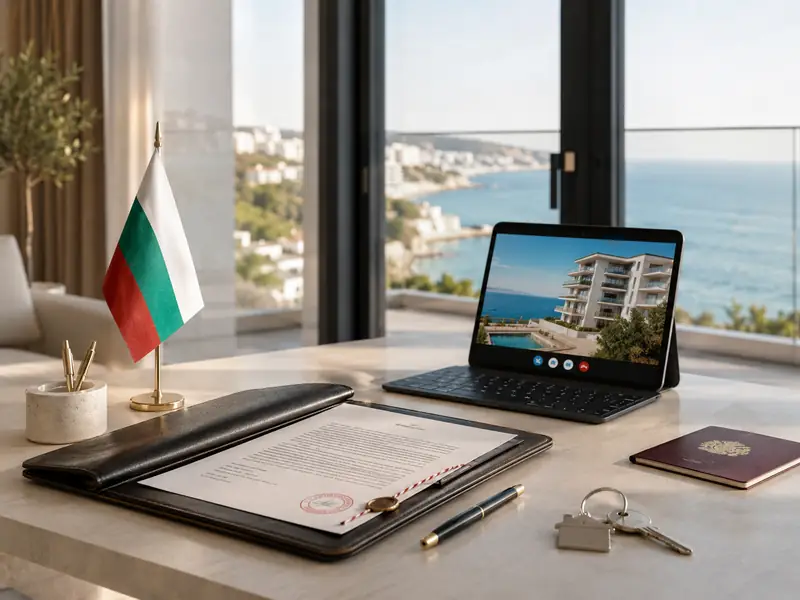
You don't have to be there in person. You can sell an apartment in Bulgaria without ever boarding a plane — someone else will stand in front of the notary for you, holding a power of attorney.
But the power of attorney is exactly where more than half of these sales stumble. People go to a notary back home in Düsseldorf or Krakow, pay the fee, get a handsome document with a seal — and the Bulgarian notary refuses it. The deal stalls, the buyer gets nervous, and the seller sits abroad with no idea what went wrong.
Here is what goes wrong, and how to get it right the first time.
Why an ordinary power of attorney is not enough
A sale of an apartment in Bulgaria is executed as a notary deed. The law says: if the transaction itself requires notarial form, then the power of attorney for it must be certified in a special way — the notary certifies not only the signature of the person granting it, but also the text of the document itself. And does both at the same time, in a single act.
That "and the text too" is the whole problem.
Any notary in any country can certify a signature. It is a simple act: the person shows up, shows a passport, signs in front of the notary. Certification of the content is a different matter: the notary takes responsibility for what the document says.
A notary abroad usually certifies the signature only. A Bulgarian notary will not accept a power of attorney like that, and he will be right.
Two routes that work
The first — a Bulgarian consulate or embassy. Bulgarian consuls are entitled to certify both the signature and the content of a document. That is exactly what is needed. On top of that, such a document counts as Bulgarian: no legalisation, no translation, no apostille.
One condition people forget: a consul certifies only documents drawn up in Bulgarian. You have to bring the text of the power of attorney with you, ready and in Bulgarian. Normally a lawyer or a notary in Bulgaria writes it and sends you the file.
The second — a local notary where you live. This route works, but with conditions. The notary must certify the signature and separately certify the content. After that the document needs an apostille. And the Bulgarian notary is entitled to ask for the text of that country's law showing that its notaries hold the same powers as Bulgarian ones.
If you cannot meet all of these conditions at once, the consulate is what is left.
Simple advice: before you go to a notary in your own country, ask the Bulgarian notary who will handle the deal whether he will accept such a document. One phone call saves two weeks.
Apostille: who needs one and who does not
If the power of attorney was certified at a Bulgarian consulate, no apostille is needed at all. Case closed.
If it was done by a local notary, it depends on the country.
Bulgaria has bilateral legal assistance treaties with a whole range of countries, and documents from them are exempt from legalisation: Ukraine, Poland, Russia, Belarus, Romania, Hungary, the Czech Republic, Slovakia, Austria, Greece, Spain, Italy, France, Cyprus and others.
Germany is not on that list. A German document travels with an apostille.
The list is kept by the Bulgarian Ministry of Foreign Affairs and it gets updated. Check it on the day of the deal rather than from memory — not least because practice differs from one notary to another.
Ready-to-move furnished homes — resale apartments by the sea.What has to be inside
A power of attorney to sell is not a general "I authorise you to represent my interests" paper. It has to be specific.
It describes the property itself: the town, the district, the exact address, the area, the boundaries, the neighbours, the cadastral identifier. So that mixing it up with anything else is impossible.
The powers are spelled out separately: to sell, to sign the notary deed, to receive the money, to sign documents at the cadastre. And separately — the price, or the minimum price below which the property may not be sold.
A real case shows how serious this is.
In 2008 an 81-year-old woman in Sofia had her money stolen. Two days later a man came up to her, introduced himself as a police officer and said that to get the money back she had to sign some papers. She signed. The papers turned out to be a power of attorney — and under it the "representative" sold her apartment to himself.
The Sofia Court of Appeal declared the sale void. One of the grounds was that the power of attorney did not state the city and the neighbourhood — the apartment was not described precisely enough. Which means the apartment sold was not the one the powers had been granted for.
The Supreme Court of Cassation set that ruling aside on procedural grounds and sent the case back, but on the substance it spoke plainly: if a power of attorney is not in the form the law requires, or if the property sold under it is not the one described in it, the representative acted without authority.
Decision No. 52 of 14.05.2021 in civil case No. 4923/2019, Supreme Court of Cassation, Fourth Civil Division.
The moral is twofold. Describe the property down to the last digit. And a power of attorney is a tool that lets someone dispose of your apartment without you, so it must not be handed to just anyone.
Declarations: nobody can sign these for you
This is where even people who got the power of attorney right come unstuck.
Besides the power of attorney, the seller signs several declarations. And here is the key point: the circumstances in those declarations cannot be declared by the authorised representative — even if you expressly authorised him to do it. The seller has to certify them personally.
What the seller signs:
- Declaration of citizenship and civil status. Your marital status: whether you have been married, when the marriage was entered into, when it was dissolved, and with whom. Both your status at the time you bought the apartment and your status now matter.
- Declaration under the tax procedure code. Since 3 May 2024 the old "I have no debts" certificate has been abolished. Instead the seller gives consent for the notary to check him electronically with the Bulgarian tax authority for outstanding debts. It is certified in two copies. The buyer does not sign this declaration.
- Declaration that you are not a politically exposed person — under the anti-money-laundering law. Both parties sign this one.
These can also be certified at a Bulgarian consulate. Or by a local notary — but then with an apostille and legalisation.
Make a separate note of the date. The declaration of citizenship and civil status is valid only until the end of the calendar year in which it was certified. Certified in December — dead by January, and the whole thing has to be done again.
Practical conclusion: do not start the paperwork at the end of December.
Translation
If a document is not drawn up in Bulgarian, it needs a translation by a licensed translator, and the translator's signature has to be certified by a notary.
Since 1 March 2018 notaries all over Bulgaria do this, not only the Ministry of Foreign Affairs in Sofia as before. It has become noticeably faster.
If you went through the consulate and the document is in Bulgarian from the start, this part does not concern you.
How long it lasts and how to revoke it
If no term is written into the power of attorney, it is open-ended. It stays in force as long as you are alive and have not revoked it. Many people do not know this and spend years with a forgotten power of attorney sitting in a stranger's hands.
A power of attorney is revoked in the same form in which it was granted — that is, with notarial certification as well. Any notary can do it, not necessarily the one who certified the original.
Bulgarian notaries enter both certified and revoked powers of attorney into the single electronic register "Edinstvo" at the Notary Chamber. So the revocation is visible to every notary in the country.
An important detail: one trip to the notary is not enough. You need a document showing the date on which you notified the representative himself of the revocation. Either he signs that he has been notified, or a notarial invitation is sent to him.
About the money
State separately in the power of attorney whether the representative has the right to receive the money for the apartment.
Most sellers living abroad avoid that clause and ask for the transfer to go straight to their own bank account. That is your right and it is normal practice — the buyer does not care which account he pays into.
In short
You do not need to come. What you need is a power of attorney certified the way Bulgarian law requires — both the signature and the content, at the same time.
The safest route is the Bulgarian consulate in your country, with the text in Bulgarian prepared in advance.
You sign the declarations yourself. One of them only lives until 31 December.
The property in the power of attorney is described down to the cadastral number.
If you are selling an apartment in Bulgaria while living in another country, we take the organisation of the deal on ourselves — from drafting the text of the power of attorney to the day at the notary.
If you are looking at new builds — see new-build apartments by the sea in Bulgaria.What this article is based on
- The requirement to certify the signature and the content at the same time — чл. 37 Закона за задълженията и договорите (ЗЗД) (Obligations and Contracts Act).
- The powers of Bulgarian consuls and the Bulgarian-language requirement — чл. 84 Закона за нотариусите и нотариалната дейност (ЗННД) (Notaries and Notarial Practice Act); Правилник за легализациите, заверките и преводите на документи и други книжа (Regulation on the legalisation, certification and translation of documents), чл. 1, ал. 1.
- A foreign notary as a rule certifies the signature only — Ruskov und Kollegen, «Нотариални сделки чрез пълномощник. Упълномощаване от чужбина».
- The requirement of separate certification of the content, the apostille, and the text of the law on a foreign notary's powers — notary Mariela Kaloyanova, citing an article by Prof. Nikolay Natov in «Нотариален бюлетин» (Notary Bulletin) of the Notary Chamber.
- The list of countries exempt from legalisation under bilateral treaties — МВнР на Р България, «Правна помощ» (Legal assistance) reference; Germany is not on the list.
- Declarations cannot be signed through a representative; the list of declarations; the declaration under чл. 25, ал. 8 ЗННД is valid until the end of the calendar year — Адвокатско дружество «Кънчев, Гичева, Марникас и партньори» (law firm).
- Abolition of the no-debts certificate and the switch to electronic checks with the tax authority from 03.05.2024 — amendments to чл. 264 ДОПК (Tax and Social Insurance Procedure Code); declaration under чл. 74, ал. 2, т. 1 ДОПК.
- Notarial certification of the translator's signature by notaries since 01.03.2018 — чл. 21а Правилника за легализациите (Regulation on legalisations).
- The open-ended nature of a power of attorney, the revocation procedure, the "Edinstvo" register — чл. 38, ал. 2 and чл. 41 ЗЗД (Obligations and Contracts Act).
- The court case — Решение № 52 от 14.05.2021 г. по гр. д. № 4923/2019 г., ВКС, IV гражданско отделение.




