Short answer: an apartment in Bulgaria can be bought by a citizen of any country in the world — no residence permit, no Bulgarian company, no permissions. A house with a plot of land, however, cannot be sold directly to a foreigner from outside the European Union: they cannot own land. There is a solution, and it is entirely legal — I break it down step by step below.
I run a real estate agency on the Bulgarian coast and I see this question in almost every first conversation. People read online that "foreigners are not allowed" and drop the idea, although the restriction applies only to land, not to housing in general.
Can a foreigner buy property in Bulgaria
Yes. Citizenship does not matter. The buyer can be a citizen of Ukraine, Kazakhstan, Israel, Germany, the United Kingdom — anyone. No residence permit is needed for the purchase, and you do not have to live in Bulgaria.
There is only one difference between citizens of different countries: whether they may own land. That single point is the reason the myth exists that foreigners cannot buy anything in Bulgaria.
What the law says: buildings for everyone, land not for everyone
In Bulgarian law a building and the land beneath it are two separate objects, governed by different rules.
Land is covered by Article 22 of the Constitution of Bulgaria. Foreigners and foreign legal entities may acquire ownership of land only in three ways: under the conditions arising from Bulgaria's accession to the European Union, under an international treaty ratified by Bulgaria, or by inheritance under the law.
Buildings are covered by Article 29 of the Property Act. A foreigner and a foreign legal entity may acquire ownership of buildings and limited real rights over property, unless the law provides otherwise.
In plain language: an apartment is part of a building, the buyer does not acquire the land underneath it — that land stays in the common parts of the building. So anyone can buy an apartment, with no reservations. A house stands on a plot, and a plot is land, which is where the restriction begins.
Who can buy an apartment in Bulgaria
Everyone. No exceptions by citizenship.
An apartment, a studio or a maisonette in a residential complex is bought by an individual, on an ordinary international passport. All you need is a Bulgarian identification number for foreigners, and the notary issues it during the transaction itself — you do not have to chase it separately.
A garage and a parking space in an underground car park are also part of the building and are also bought freely.
Who can buy a house in Bulgaria
Here the answer splits in two.
Citizens of European Union and European Economic Area countries buy a house with its land directly, in their own name, exactly as Bulgarians do. This is written into the same Article 29 of the Property Act: they acquire ownership of land under the terms of Bulgaria's EU Accession Treaty.
Citizens of non-EU countries cannot buy land as private individuals. What they can do:
- buy the house as a building and take a long-term lease on the land or register a right to build — this is rarely done, the arrangement is awkward on resale;
- register a Bulgarian company and buy the house together with the land in the company's name — this is the workable and by far the most common route;
- inherit the property under the law — the restriction does not apply at all in that case.
Why a house with land is bought through a Bulgarian company
Because a Bulgarian company is a Bulgarian legal entity, even when its sole owner is a citizen of Ukraine or Kazakhstan. In the eyes of the law the buyer of the land is Bulgarian rather than foreign, and the restriction in Article 22 of the Constitution does not apply.
The second reason is Article 92 of the Property Act: the owner of the land owns the buildings on it. Splitting a house and its plot between two different owners takes a special legal construction; by default they travel together. So buying the whole thing through a company is simpler than building a workaround.
What a Bulgarian company costs and what you do with it afterwards
Registering an OOD — the Bulgarian equivalent of a limited liability company — takes from a few days to two weeks. The share capital is minimal, a symbolic 2 leva. Registration with a lawyer usually comes to 400–600 euro; the exact figure is quoted by the lawyer, I am not inventing it.
After that the company carries an obligation: it files annual accounts every year, even if it did nothing. That costs roughly 150–300 euro a year to an accountant. Treat it as a fixed line in the cost of owning the house — that is more honest than finding out about it a year later.
☝️ Worth knowing in advance: when you come to sell such a house, an EU buyer would rather buy the property directly than buy your company. It is not a dead end, but reselling a house held through a company is a little harder than reselling an apartment. In that sense an apartment is simpler and more liquid.
What documents the buyer needs
- An international passport — that is all you need for an apartment;
- a Bulgarian identification number for foreigners — issued by the notary during the transaction;
- a power of attorney if you are not attending the signing in person — notarised and translated into Bulgarian;
- for a house through a company — the company's incorporation documents.
The transaction takes place before a Bulgarian notary. The notary checks the property against the state register, draws up the title deed and enters the transaction into the Property Register. Without a notary, ownership in Bulgaria does not change hands at all.
Purchase tax and the other costs
The tax on the acquisition of property for consideration is set by the Local Taxes and Fees Act. The rate is set by each municipal council and falls between 0.1 and 3 per cent of the valuation of the property. The base is the agreed price, or the tax assessment if that is higher.
The buyer pays the tax, and pays it in the municipality where the property is located. That is why the rate in Nessebar and in Burgas can differ — that is normal, it is a decision of the local council, not an error.
Besides the tax, the transaction budget includes the notary fee, the Registry Agency fee and an interpreter if you do not speak Bulgarian. For an apartment, people usually budget 3–4 per cent on top of the price.
Does buying property give you residency
By itself, no. Buying an apartment on the coast gives you neither temporary nor permanent residence nor citizenship, and anyone who promises otherwise is selling you something they do not have.
Routes to residency through property in Bulgaria do exist, but they are more complicated and require different amounts and conditions. I have covered that separately so as not to mix two topics in one text.
Three mistakes I see most often
The first is deciding that "foreigners are not allowed" and never looking at the market at all. Only land is restricted, and only for non-EU citizens. Apartments are not affected.
The second is buying a house with a plot as a private individual without checking. A notary simply will not complete that transaction, and the deposit can get stuck.
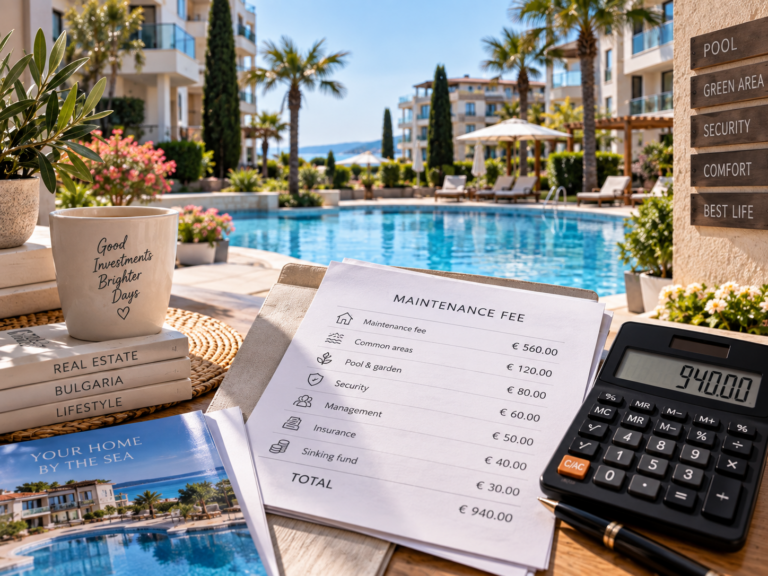
The third is budgeting only for the price of the property. Municipal tax, the notary, the annual maintenance fee of the complex and the upkeep of the company, if you have one, are real money — better seen before the deal than after it.
What to read next
- Property in Bulgaria and residency — what a purchase actually gives you
- Property in Bulgaria for retirees
- Buying an apartment in Bulgaria: pros and cons — an honest list of the downsides
- Catalogue of apartments on the Bulgarian coast
What to do next
If you are looking at an apartment, there are no citizenship restrictions on you at all — you can start choosing a property straight away. If you are looking at a house and you are not an EU citizen, work out the cost of the company first and choose the house second, so the number does not come as a surprise.
We check prices and availability against developers' price lists every week, so the catalogue holds live properties rather than a shop window a year out of date.
Sources: Constitution of the Republic of Bulgaria, Article 22; Property Act, Articles 29, 29a, 92, 110; Local Taxes and Fees Act, Articles 44–51; Ministry of Finance of Bulgaria — section on the tax on acquisition of property for consideration.