I wrote this for people who have been reading about Bulgaria for a month and still have not decided. There is not a single enthusiastic paragraph here, and not a single alarming one. There are five reasons to buy and six reasons not to — all of them from my own practice, not from a brochure.
Read to the end. The downsides are at the bottom not because I am hiding them, but because without the upsides they do not make sense.
In short: who Bulgaria suits and who it does not
Bulgaria suits someone buying a home for themselves and their family: to come in summer, to stay for months, to retire by the sea, to move their parents over. The entry price is low, the climate is mild and the purchase procedure is straightforward.
Bulgaria does not suit someone looking for an investment with predictable yield. A flat by the sea is not a bond. It can sit at the same price for years, and renting it out takes more effort than it pays if you do not live nearby.
If you recognised yourself in the second paragraph, you can stop reading. If in the first — here is the detail.
Upside one. A citizen of any country can buy
A flat in Bulgaria can be bought by a citizen of any state. You need no residence permit, no Bulgarian company and no permission from any authority. A passport and a Bulgarian tax number, issued in a single visit, are enough.
The restriction applies only to land: a citizen of a country outside the European Union cannot register a plot in their own name. But this does not affect flats in an apartment building — there the land is a common part of the building, and the buyer owns a share of it together with all the neighbours.
A detailed breakdown with the relevant statutes is in a separate article, linked at the end.
Upside two. The entry price is lower than on any other EU coast
This is the main reason people look at Bulgaria at all. Figures from our catalogue as of September 2026:
- a studio near the sea — from 33,500 euros;
- a flat with a separate bedroom — from 68,000 euros.
Compare that with Spain, Italy or Croatia. For the same money you will not buy anything within half an hour of the sea there. That is why people come to Bulgaria not only for an investment but simply for a second home.
An honest caveat: a low price is always a trade-off with something. Either a modest floor area, or a floor without a view, or a complex away from the resort centre. There is no free lunch here — there is a clear exchange.
Upside three. Purchase tax is 0.1 to 3 per cent
The acquisition tax is paid by the buyer. The rate is set not by the state but by the council of the municipality where the building stands, and by law it falls between 0.1 and 3 per cent of the assessed value of the property.
The tax is calculated on the higher of two figures: the agreed price or the tax valuation of the property. It is paid in the municipality where the flat is located.
What that means in practice: on a 60,000 euro flat the purchase tax differs several times over between coastal municipalities. Ask for the exact rate of your municipality before the deal, not after — it is one line of a question, but it moves the budget by a thousand euros or more.
Upside four. Developer instalments without a bank
Bulgarian developers sell on instalments themselves, without a bank, without income statements and without a credit check. The typical scheme is part of the sum on signing and the balance in equal payments until completion.
This is a real advantage, not a marketing one. Someone whose own bank will not lend against foreign property buys here with no bank at all.
Two limits that are rarely mentioned. First: instalments exist for flats in new builds; for houses they are almost never offered. Second: instalments longer than a year almost always carry a mark-up — the price rises for each additional year. Do not ask "are instalments available", ask "what will the flat cost if I pay over three years".
Upside five. The coast lives all year, not four months
A common misconception: in winter the Bulgarian coast is empty and everything is shut. That is untrue for the towns. In Burgas, Nesebar, Pomorie and Sveti Vlas the schools, clinics, shops and buses run through winter, because people live there — not only holidaymakers who arrive.
The truth is different: seasonality is a property of the individual complex, not of the town. A large resort complex with a pool and security can stand almost empty in winter, while a building in a residential quarter three streets away carries on as usual.
So the question "what is it like here in winter" should be asked about the specific address, not about the resort. Those two buildings will give you different answers.
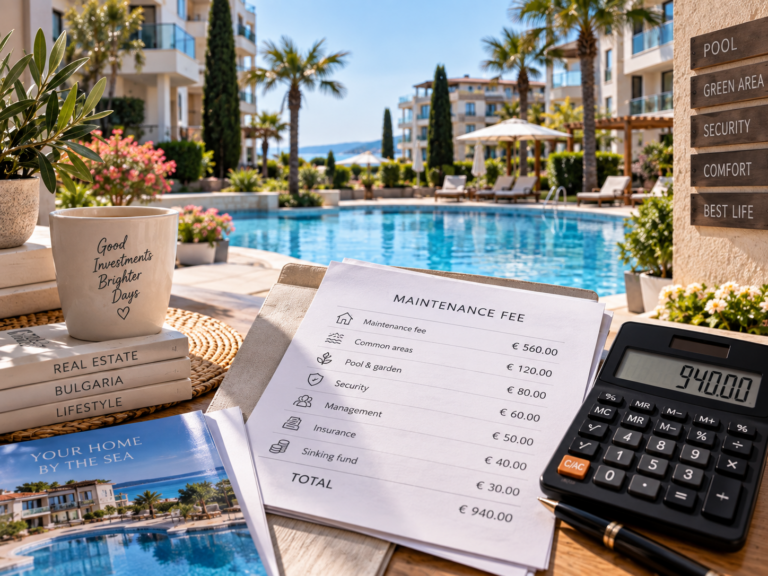
Downside one. The maintenance fee is a cost that never ends
This is the first thing people forget. A complex with a pool, security and grounds carries an annual maintenance fee. It is charged per square metre per year and is payable whether you live in the flat or not, whether you rent it out or it stands locked.
The spread between complexes is enormous — several times over. A building with no pool and no security may have no fee at all; a large resort complex with landscaping and a water zone turns it into a noticeable sum every single year.
Count it before you buy, and multiply it by ten years. Sometimes a flat that costs three thousand more works out cheaper over a decade than the one next door, on the strength of the fee alone.
Downside two. "Obshta plosht" — you pay for more than your own walls
In Bulgarian documents the area of a flat is called obshta plosht, and it covers more than the rooms. It includes terraces, the thickness of the walls and a share of the building's common parts — stairs, lifts, corridors.
This is the norm, every developer in the country counts this way, and it is not a trick. But a buyer used to "living area" sees 60 square metres in the paperwork, arrives, and finds roughly 48 inside.
The conclusion is simple: when you compare two flats by price per square metre, you are comparing two obshta plosht figures. And when you work out whether a family fits, look at the layout and the rooms, not at the number in the price list.
Downside three. Renting out is not passive income
The most frequent question I get is "how much will it bring in". I answer with figures, and I say straight away what sits behind them.
In season a studio on the coast rents at 40–50 euros a night, a flat with a separate bedroom at 60–80. Those are good numbers. But the season is a few months, not a year, and occupancy within it is not a hundred per cent.
Then comes the part nobody mentions. The complex management company does not handle long-term letting and guarantees no yield whatsoever. Short-stay letting is done by you or by a hired person on the ground: meeting guests, checking them in, cleaning, laundry, answering a message at midnight. Out of the gross take go the platform commission, cleaning, linen, utilities and that same maintenance fee.
If you live in another country and are not willing to manage anyone, treat the purchase not as an investment but as a second home that sometimes partly pays for itself. That is more honest, and it leaves no room for disappointment.
Downside four. You will not resell quickly
A resort flat is an illiquid asset. There are several times fewer buyers for it than for town housing, and they are concentrated in the same few months when people come to the sea.
That means listing a flat and selling it within a month at a good price is close to impossible. A sale takes a season, sometimes two. Anyone who needs the money urgently sells at a discount.
The conclusion: do not buy with money you may need in a year. Buy with money you are content to leave in a wall for five years or more.
Downside five. You cannot register the land under a house
If you are looking at a house with a plot rather than a flat, and you are not an EU citizen, you cannot buy the land as a private individual. The house you can own; the land under it you cannot.
There is one working solution: a Bulgarian company, registered to you, which owns the plot. It is lawful and it is done all the time, but it is neither free nor one-off. The company acquires annual reporting and obligations even if it does nothing but hold the land.
So a house with a plot is always one structure more complicated than a flat. For many people that is the deciding argument in favour of a flat.
Downside six. Until Act 16 is issued, you own a building site
Act 16 is the document putting a building into service. Until it is issued you cannot register an address in the flat and you cannot legally live there, even if the building looks finished and the neighbours are already moving furniture in.
Buying off-plan is cheaper and it is a normal way in. But the risk of the schedule slipping sits with the buyer, and on Bulgarian sites a slip of one season is routine.
A simple rule: if you need the flat by a particular summer, take a building that already has Act 16. If you have a year or more of slack, construction will give you the better price.
So — buy or not
Buy if you are taking a home for yourself, are prepared to hold it for years, and have counted the maintenance fee ten years ahead. In that scenario Bulgaria beats every other EU coast on the ratio of price to sea.
Do not buy if you are counting on guaranteed rental income or plan to resell at a profit in a year. Those two expectations do not come true here, and it is better to learn that now than in two years.
And do not buy without coming. Photographs show neither the uphill walk to the sea, nor the noise from the road, nor what the courtyard looks like in July. One trip costs less than one mistake.
Further reading
- Who can buy property in Bulgaria — the law, the documents, the purchase tax.
- Property in Bulgaria and a residence permit — what a purchase gives you on paper and what it does not.
- Property in Bulgaria for retirees — costs, healthcare, life in winter.
What to do next
Look through the catalogue of coastal flats: every listing shows the area, the floor, the distance to the sea and the maintenance fee — exactly the figures a decision is built from.
If you would like me to shortlist options for your budget and work out the running costs, write to me.