
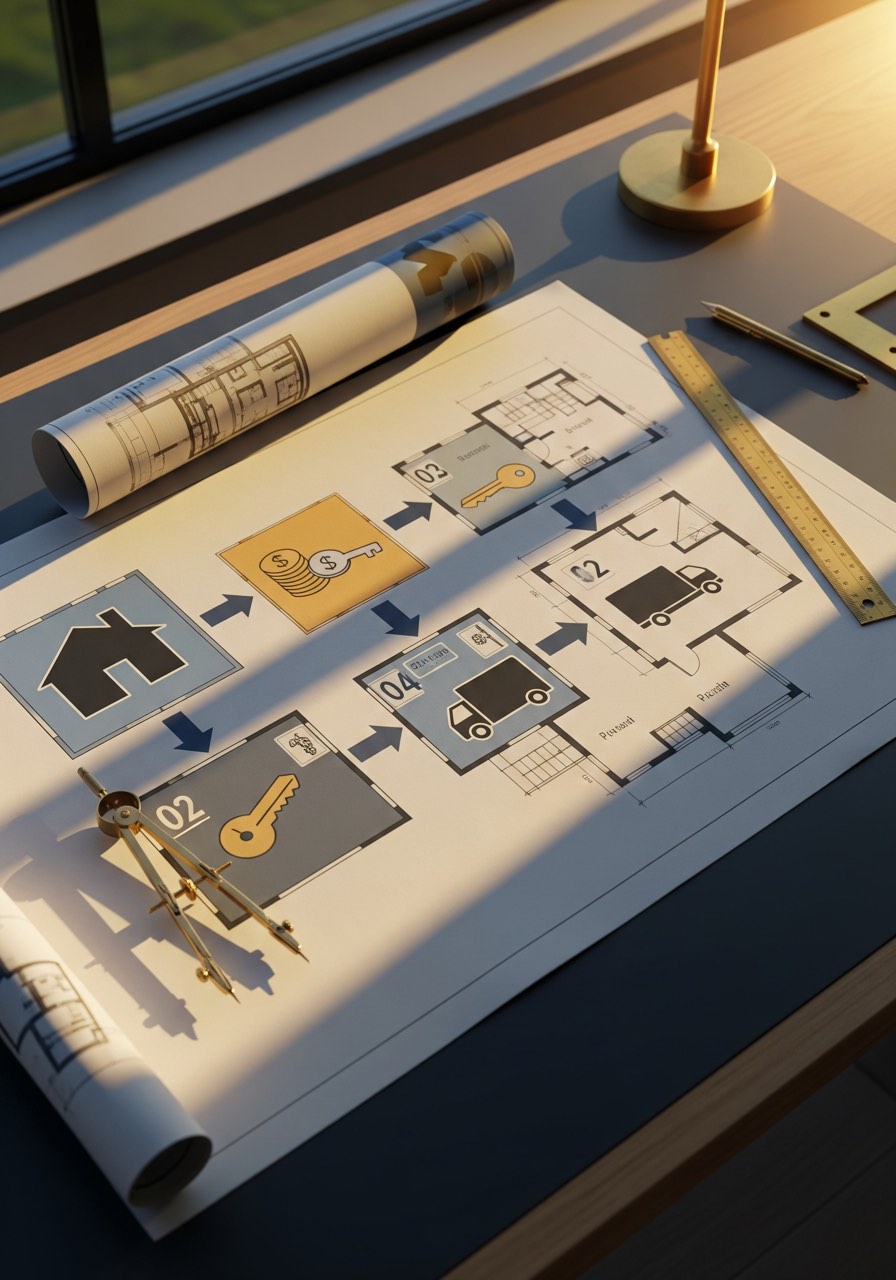
How to Buy an Apartment in Bulgaria as a Foreigner: Step-by-Step Guide 2026
This guide is a summary of everything I explain to every buyer at the first meeting. Not a glossy brochure — a working framework: who can buy, what to sign, how much to pay above the property price, and what to do after the notary. Reading time: 11 minutes. It will save you several months of going in circles.
In brief:
A foreigner — citizen of any country — can buy an apartment or residential unit in Bulgaria without restrictions. Land without a building cannot be purchased as an individual if you are not an EU/EEA citizen — a Bulgarian legal entity (EOOD) is required for that. The standard timeline from property selection to notarial deed: 4–8 weeks. Additional costs above the purchase price: 5–8%. Since January 1, 2026, Bulgaria is in the eurozone: transactions proceed in euros without currency conversion or exchange risk.
Who Can Buy — and What
Bulgarian law distinguishes two types of buyers.
EU and EEA citizens purchase any property without restrictions — apartments, houses, townhouses, land — directly as individuals. The procedure is the same as for Bulgarian citizens.
Citizens of non-EU countries — Ukrainians, Russians, Belarusians, Israelis, Americans, UAE nationals, and citizens of all other states — can purchase apartments, residential units, garages, and other standalone premises directly. The single restriction: a plot of land without a building cannot be registered to an individual.
If you need a house with a private garden or a standalone plot, a Bulgarian limited liability company (EOOD) must be registered. This is standard practice, not a workaround. Registering an EOOD takes 2–3 weeks and costs approximately €1,500–2,000 including all state fees. The sole founder and director can be you, a foreign national, with no Bulgarian residence permit required.
The majority of buyers who come to me on the coast are purchasing apartments — one or two-bedroom units in complexes in Sunny Beach, Sveti Vlas, Ravda, or Nesebar. For apartments, no EOOD is needed. The purchase is registered directly in the name of the individual.
Nine Steps: From Idea to Keys
Step 1. Define Your Goal and Budget
Before looking at properties, answer three questions honestly:
- What is the purpose: personal use, rental income, or a reserve asset?
- How much can you spend including all additional costs (+5–8% above the property price)?
- Is an instalment plan needed, or is full payment possible?
The purpose determines everything else: location, floor, complex type, management company. A coastal apartment for rental income and one for personal holidays are different properties with different yields and different risk profiles.
Step 2. Choose the Area
I work in a specific region — Sunny Beach, Sveti Vlas, Ravda, Nesebar, Sarafovo, Burgas. Not all of Bulgaria. And I think that is the more honest approach: I know every complex, developer, and management company here.
Brief orientation:
- Sunny Beach — the largest resort, high liquidity, large inventory, active tourist infrastructure. Studios from €40,000.
- Sveti Vlas — quieter, marina, a more affluent rental demographic, new complexes with Act 16. Prices from approximately €55,000–60,000.
- Ravda — quiet alternative, family-oriented, lower prices at a similar distance from the sea.
- Nesebar — historic zone, restrictions on new construction, properties are more expensive and appear on the market less frequently.
If you are not sure where to start — contact me: I will select five options matching your requirements within 30 minutes.
Step 3. Property Viewings — in Person or Video Tour
A personal visit is ideal. I inspect each property before showing it to buyers. What looks good in photos can have issues with the view, noise levels, or management company.
If visiting immediately is not possible — we work remotely: a live video tour with my commentary, an honest assessment of positives and negatives. More on the remote purchase process here.
I do not show a property I would not buy myself. There are no filler listings in my catalogue.
Step 4. Legal Due Diligence
This is the most important step. It is done before paying the deposit — not after.
What is checked:
- Act 16 — the building’s occupancy permit. Without it, the building is legally not commissioned: residency registration is not possible, utilities cannot be legally connected, and BULSTAT registration may be affected. For new-builds, this is the critical document.
- Extract from the Agentsia po Vpisvaniyata — the title register. Shows who the real owner is, whether there are co-owners, mortgages, arrests, or encumbrances.
- Title history — for the past 10 years. Unexpectedly frequent resales are a reason to ask questions.
- Outstanding debts — to the management company, utility providers, and the municipality.
Legal due diligence is carried out by a Bulgarian lawyer. Cost: €300–600 depending on complexity. Do not cut costs at this step.
Step 5. Preliminary Contract and 10% Deposit
After due diligence and agreement on terms: a preliminary purchase contract (predvaritelen dogovor). It records: the parties, the property, the price, the deadline for the main transaction, and deposit refund conditions.
The standard deposit is 10% of the purchase price. If the buyer withdraws without grounds specified in the contract, the deposit remains with the seller. If the seller withdraws, they must return double the amount.
The preliminary contract is not registered with a notary — it is a private binding document.
Step 6. Obtain BULSTAT (mandatory for non-EU citizens)
Non-EU citizens who purchase property in Bulgaria are required to register with the BULSTAT Register at the Agentsia po Vpisvaniyata within 7 working days of signing the notarial deed. Missing this deadline incurs a fine of approximately 700 BGN (≈€360).
BULSTAT is your identification number as a property-owning individual in Bulgaria. It is needed for tax registration, connecting utilities, and opening a bank account.
EU citizens who have a Bulgarian personal number (EGN or LNCh) can use that instead of BULSTAT.
Step 7. Open a Bank Account and Transfer Funds
Payment for the notarial deed requires a bank transfer. Bulgarian notaries work with confirmed bank transactions.
Since January 1, 2026, Bulgaria is in the eurozone — the fixed lev-to-euro conversion rate has become history along with the lev itself. All transactions are now denominated in euros. No currency conversion, no exchange risk.
A Bulgarian bank account can be opened in person at a branch. Requirements: an international passport, proof of address, and in some banks — a residence permit or BULSTAT number. If opening an account beforehand is not possible — the transfer can be made through the account of a trusted representative or directly to the notary’s or seller’s account as specified in the contract. This is a point that we work through individually for each transaction.
Step 8. Notarial Deed
The actual transfer of title takes place through the notarial deed (notarialen akt). This is the Bulgarian equivalent of a sale and purchase agreement — but authenticated by a notary. Title transfer does not occur without this document.
Present at the transaction: the buyer (or their representative under a notarial power of attorney), the seller, and the notary. For foreign buyers, the notary is required to engage a certified interpreter — this is a statutory requirement, not optional.
The notary verifies: the identities of the parties, the property documents, the absence of encumbrances, and payment. After signing, the notary registers the transaction with the Agentsia po Vpisvaniyata on the same day.
What to bring:
– International passport (original)
– Preliminary contract
– Payment confirmations (bank receipts)
– Power of attorney — if a representative is acting
Step 9. Registration and Tax Declaration
After the notarial deed, the notary submits documents to the Agentsia po Vpisvaniyata (the property register). Registration takes 1–3 working days. You are then the official owner.
Within 2 months of registration: file a declaration with the local tax authority (municipality) to register the property for tax purposes. This is the basis for the annual property tax and waste collection charge. Filed once; taxes are assessed automatically each year thereafter.
Costs at Purchase: What You Pay Above the Property Price
| Cost item | Amount | Note |
|---|---|---|
| Municipal transfer tax | 2–3% | In Nesebar, Burgas, Sunny Beach — 3%. Calculated on the higher of: transaction price or tax assessment |
| Notary fees | 0.1–1.5% (max ~€3,000) + 20% VAT | Stepped scale, decreasing percentage as the sum increases |
| State registration fee | 0.1% | Based on the higher of: transaction price or tax assessment |
| Interpreter at the notary | ~€50 | Mandatory for foreign buyers |
| Legal due diligence and representation | €300–600 | I strongly recommend not skipping this |
| Total approximate | 5–8% of the property price | Depends on the transaction amount and property |
If an EOOD registration is required (for purchasing land or a house with garden): add €1,500–2,000 as a one-off cost.
When buying a new-build directly from a developer, VAT at 20% may apply instead of the municipal transfer tax — this is a different legal situation; confirm for each specific property.
If you are looking at new builds — see new-build apartments by the sea in Bulgaria.
How Long the Process Takes
Standard process (apartments, secondary market or new-build with Act 16):
- Property selection and negotiation: 1–2 weeks
- Legal due diligence: 3–5 working days
- Preliminary contract and waiting period: 1–4 weeks (depends on agreement with the seller)
- Fund transfer and preparation for the notary: 3–7 working days
- Notarial deed + registration: 1–3 working days
Total: 4–8 weeks from the first viewing to receiving the registered notarial deed.
If EOOD registration is required: add 2–3 weeks before the main process begins.
If buying a new-build without Act 16: the key handover date is set by the developer — that is a separate conversation with different risk considerations.
Common Buyer Mistakes
1. Paying a deposit before legal due diligence.
The most expensive mistake. Checking the property for encumbrances, Act 16, and debts must happen before — not after. After the deposit, your negotiating position is weak.
2. Focusing only on price per square metre.
A complex without Act 16, with management company debts, or an opaque developer can cost €800/m² and result in years of legal complications. Legal cleanliness matters more than price.
3. Ignoring the maintenance fee.
The annual complex maintenance charge can run from €10 to €40+ per m² per year in some gated complexes with pools. This is a fixed ongoing cost that directly affects rental yield.
4. Not checking the management company.
Bulgaria has no strict management company licensing regime. I have seen situations where a company collected fees from residents but carried out neither maintenance nor cleaning. Always ask for feedback from actual residents of the complex — not from the selling agent.
5. Delaying BULSTAT registration.
7 working days is a hard deadline. For non-EU citizens, registering BULSTAT is the first thing to do after signing the notarial deed. The fine is modest in absolute terms but creates administrative complications for subsequent steps.
Frequently Asked Questions
Do I need a visa to buy an apartment in Bulgaria?
No. Bulgaria has been part of the Schengen Area since 2024. Citizens of most countries enter without a visa for up to 90 days. No special permit or visa is required for the purchase itself.
Can a Ukrainian citizen buy an apartment in Bulgaria?
Yes. Ukrainians purchase apartments as individuals without restrictions. Land — through an EOOD. Detailed guide for Ukrainian buyers here.
Is a Bulgarian lawyer necessary?
The law does not require one — but I strongly recommend one. The lawyer checks legal cleanliness, drafts or reviews the preliminary contract, and represents you at the notary. Cost: €300–600. At a transaction value of tens of thousands of euros, skipping this is not justified.
Can I buy remotely without visiting Bulgaria?
Yes. A notarially certified power of attorney is granted in favour of a representative — this can be certified at the Bulgarian consulate in your country or by a local notary with an apostille. Full scheme for remote purchase here.
Does buying property give the right of residence?
On its own — no. Property in Bulgaria is not an automatic basis for a residence permit. Investor programmes exist but are separate and require legal consultation. More in the article [Residency Through Property in Bulgaria: What Is Actually Possible in 2026].
How did the purchase process change after the euro transition in 2026?
It fundamentally simplified. Bulgaria joined the eurozone on January 1, 2026. All transactions are now in euros. There is no longer any conversion from lev, and no exchange risk between the preliminary contract and the notarial deed. For international buyers this is an unambiguously positive development. More on the euro transition and prices.
What is Act 16 and why check it?
Act 16 is the official building occupancy permit issued by the state. Without it, the building is formally incomplete: residency registration is not possible, utilities cannot be legally connected, and full title registration may be affected. For new-builds — mandatory to check before the deposit. Act 16 in detail.
How much does annual maintenance cost?
Annual property tax — modest, calculated on the tax-assessed value (typically below market price). Maintenance fee (complex upkeep) — variable, from €10 to €40+ per m² per year depending on the complex level and service package. Running costs in detail — in the tax guide.
Can I rent out the apartment immediately after purchase?
Yes, if the apartment is registered and has Act 16. Short-term rental through Booking.com or Airbnb requires registration in a special registry. If you want to rent through the complex’s management company — a separate contract with them is needed. For realistic rental yield calculations, see the dedicated article.
How do I transfer payment for the apartment?
Bank transfer is the standard method. Since 2026, everything is in euros without conversion. Buyers from different countries have different routes: check current National Bank restrictions if applicable, and consult your bank about international transfer conditions. A guide to legal money transfer routes to Bulgaria is in a separate article.
What to Do Next
If you have read to this point, you already understand the process better than most people who begin looking at properties.
The next step depends on where you are now:
- Still choosing a region — browse the catalogue: properties in Sunny Beach, Sveti Vlas, Ravda, and Nesebar with current prices and Act 16 status.
- Specific questions about the process — write to me directly. I respond personally, not through a call centre.
- Ready to start — I will select five options matching your budget and goals within 30 minutes: contact Vikki Dronova.
No rushing, no filler listings. Your home, your rules.
All current listings — apartments in Nessebar. Prices, sizes and floors in the catalogue.
Vikki Dronova — property broker, Sveti Vlas, Bulgaria. 17 years in design, 5 years in real estate. EGOIST Estate, ★ 5,0 Google.




