
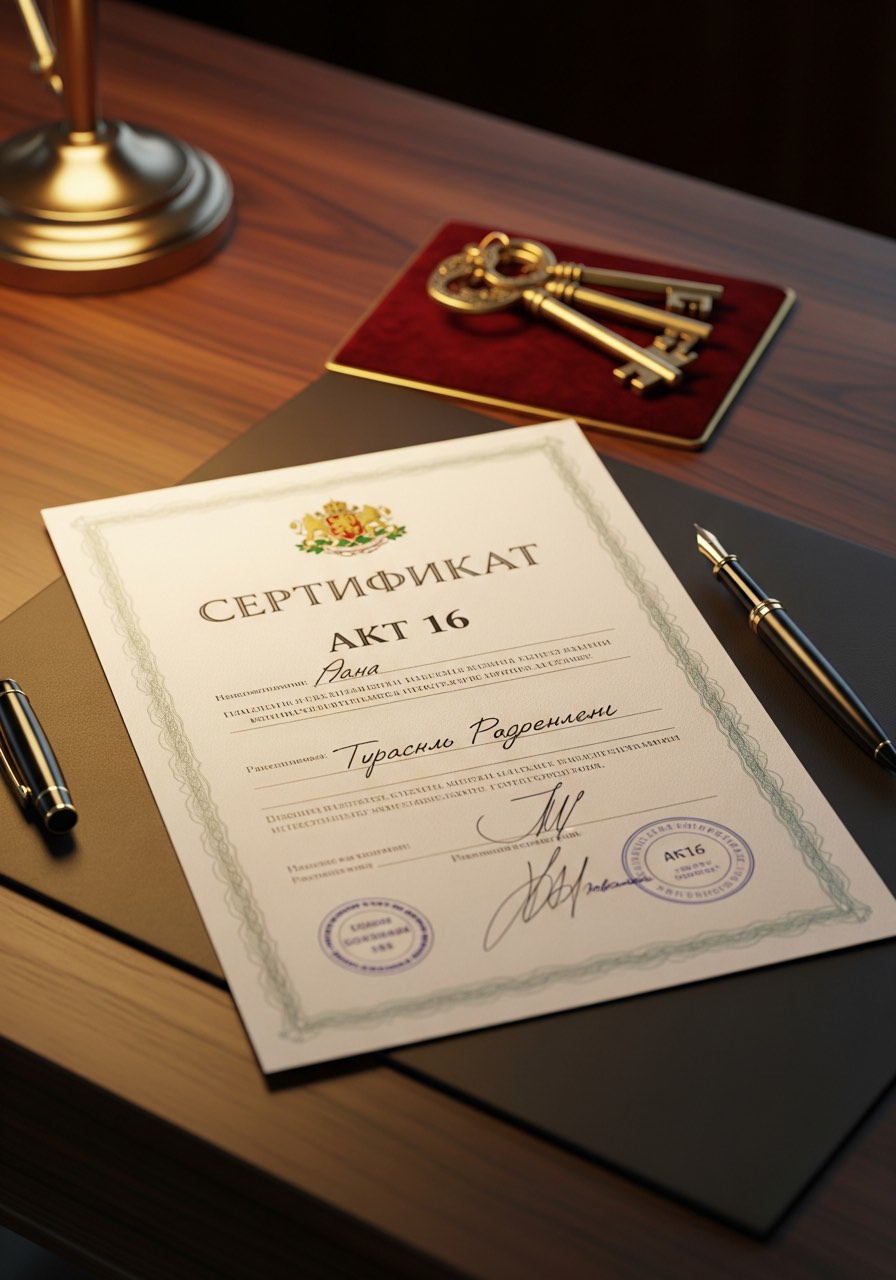
Act 16 in Bulgaria: What It Is and How to Verify It Before Paying a Deposit
The first thing I check before any transaction is Act 16. Not the price, not the view, not the finishes. Act 16. Because without it, a property is legally a construction site — regardless of how finished it looks from the outside or inside.
In more than four years of working in Bulgarian real estate, I have seen properties that look perfect but have been sitting with unresolved documentation for years. Buyers move in, pay utility bills at commercial rates, cannot register an address, and eventually sell at a loss. This article explains how to avoid that outcome.
In brief: Act 16 (Razreshenie za polzvane) is the final government document authorising a building for occupancy in Bulgaria. Without it, you cannot open individual utility accounts, obtain a registered address, or legally register the property for tourist rental. You can verify it for free at dnsk.bg. Always check before paying a deposit.
What Act 16 Is and Why It Matters
Act 16 — officially called Razreshenie za polzvane (Permit for Use) under Bulgarian law — is the final government permit authorising a building for use and occupancy. It confirms that the construction complies with the approved design, technical standards, and sanitary requirements.
The permit is issued by DNSK (Direktsia za Natsionalen Stroitelen Kontrol — the national construction control authority). For certain building categories, the chief municipal architect may issue it instead. The legal basis is Article 177 of the Zakon za Ustroystvo na Teritoriata (ZUT — the Spatial Planning Act).
The essential point: until Act 16 is issued, a building is legally treated as an unfinished construction object. It does not matter that all apartments are renovated, the pool is full, and the reception desk is staffed. Without Act 16, it is a building site in the eyes of the law. That single fact determines the entire list of practical restrictions described below.
Act 14, Act 15, and Act 16: What the Difference Is
Bulgarian construction practice involves several intermediate documents that are frequently confused. Here is how they relate to each other:
| Parameter | Act 14 | Act 15 | Act 16 |
|---|---|---|---|
| What it records | Completion of the structural frame: skeleton, walls, roof | Full building readiness; all project participants have signed | State acceptance for occupancy |
| Who signs | Designer, construction supervisor | All project participants and designers | DNSK or the chief municipal architect |
| Can the property be sold? | Yes — a preliminary contract is possible | Yes | Yes |
| Can people live there? | No | No | Yes |
| Individual utility accounts | No | No | Yes |
| Registered address | No | No | Yes |
Act 15 says a building is finished. Act 16 says people can live in it. These are different things — though developers frequently present Act 15 as the “final document” in negotiations.
One important clarification: selling at Act 14 or Act 15 stage is entirely legal. A developer may sign a preliminary contract and accept a deposit at any stage of construction. The question is not legality but what is written in the contract and what guarantees you have regarding Act 16.
Why Developers Delay Getting Act 16
This is one of the questions I receive most often. The building is standing complete, people are living in it, and Act 16 has not arrived for two years. Why?
There are several reasons, and they are not mutually exclusive.
Tax motivation. Historically, Bulgarian property tax accrued from the moment Act 16 was issued. A later occupancy permit meant a later start to tax obligations for the developer. Legislative amendments changed this: tax now accrues from Act 15. But some developers have not yet restructured their financial models around the new rules.
Incomplete infrastructure. For Act 16, a building must be connected to municipal networks: water supply, sewage, electricity. If the utilities are not connected or have not been handed over to the municipality, DNSK will not issue the permit. This is particularly relevant for new complexes that were built faster than the surrounding urban infrastructure could accommodate.
Developer financial problems. A developer sold apartments, received payments, but did not complete the common areas: pathways, landscaping, parking, lobby. DNSK will not accept the building until everything matches the approved design documents. There is no money to complete the work — it has run out.
I saw one such case personally. A complex in Kosharitsa, seven blocks. The sewage connection never reached the building — the complex was constructed 4 km from the nearest connection point, and by the time it became clear that the connection would have to be funded by the complex itself, the developer was out of money. Residents lived for several years without Act 16, without being able to register a residency address, and without standard utility tariffs. Property title registration at the Agentsia po Vpisvaniyata remained possible — the notarial deed was not affected — but occupancy rights stayed limited.
If you are looking at new builds — see new-build apartments by the sea in Bulgaria.
Risks of Buying Without Act 16
The list below is not theoretical. Every one of these scenarios is something I have encountered in actual transactions in the Sunny Beach and Sveti Vlas area.
- No individual utility meters for water and electricity. The entire complex receives electricity and water under a single commercial contract. The tariff is significantly higher than a residential one. How costs are split between residents is decided by the management company, with limited oversight from owners.
- No permanent registered address. Without one, you cannot apply for a Bulgarian residence permit based on your property. The apartment exists; the address for official registration does not.
- A Bulgarian bank will not issue a mortgage. If you or a future buyer want to finance a purchase with a loan secured against this apartment, the bank will decline. A property without Act 16 is not accepted as collateral.
- Legal tourist rental is impossible. To register a property for short-term rental with the Bulgarian Ministry of Tourism (apartment categorisation), a valid Act 16 is required. Listing without it on platforms such as Airbnb means operating outside the law.
- Developer insolvency. If the developer becomes insolvent before Act 16 is obtained, your position as a buyer weakens considerably. Rights over an unfinished object are less protected than rights over a building in lawful use.
- Resale becomes harder. A buyer using mortgage financing cannot purchase. A buyer seeking to register residency cannot do so. The pool of potential buyers shrinks, which puts pressure on the price when you sell.
How to Verify Act 16 Yourself: Step-by-Step
Verification takes 10–15 minutes and requires no paid services.
Step 1. Ask the seller or developer for the Act 16 number and date. If the document exists, this takes a minute. If explanations begin — “the documents are with the lawyer,” “we’ll check” — that is already a signal.
Step 2. Check the DNSK public register. Go to dnsk.bg and find the section “Publichen registar na razresheniyata za polzvane” (Public Register of Permits for Use). The search is free, no registration is needed. Enter the complex name or municipality. If Act 16 has been issued, the entry will appear in the register.
Step 3. Contact the municipality. For properties in Sveti Vlas, Sunny Beach, Ravda, and Nesebar, the relevant authority is Obshtina Nesebar (Nesebar Municipality). You can request a certificate of occupancy status for any property. This is public information.
Step 4. Look at the utility bills. If each apartment owner has an individual contract with CEZ (electricity) or the local water utility at a residential tariff, that is indirect confirmation that Act 16 has been issued. A shared bill for the whole building is a sign that it has not.
Step 5. Red flag: “Act 16 will be ready soon.” If the seller says “soon” but cannot name a specific date and does not provide correspondence with DNSK, do not pay a deposit. “Soon” in Bulgarian construction practice can mean one year, three years, or never.
Act 16 in Sunny Beach and Sveti Vlas
I live and work in Sveti Vlas. This is my market, and I know it in detail. A significant proportion of properties here were built during the construction boom of 2004–2009, when building timelines far outpaced documentation.
Some of those complexes are still operating without Act 16. Some received the document five to seven years after construction was complete; some have not received it to this day. Before recommending any property to a client, I verify Act 16 on every building. That is not an option — it is a professional standard.
The authority issuing Act 16 for the region is Obshtina Nesebar (for municipal-category construction) or the territorial branch of DNSK for Burgas Oblast. For most large residential complexes, the relevant body is DNSK, which is where to look first.
One additional note: as of January 2026, Bulgaria adopted the euro. All transactions now take place in euros, and Bulgarian bank mortgage rates are also denominated in euros. This does not affect Act 16 status but does change the financial mechanics of transactions.
Paying a Deposit Before Act 16: What to Include in the Contract
Buying at Act 14 or Act 15 stage is not a mistake by definition. Sometimes it makes sense: prices at construction stage are lower, and you can secure a good unit. But in that case, the preliminary contract (predvaritelen dogovor) must protect you specifically.
What the contract must include:
- A specific deadline for Act 16 — not “upon completion of construction” but an actual date or quarter. For example: “no later than December 31, 2026.”
- Penalty clauses for delays — a compensation amount for each month of delay.
- Conditions for deposit refund — in what circumstances and within what timeframe you are entitled to your money back if Act 16 is not obtained.
- Right to terminate — if the delay exceeds the agreed period, you must have the right to exit the transaction without losing your deposit.
In my experience, legal due diligence for a transaction above €30,000 costs €200–400 with a Bulgarian lawyer. That is a mandatory line item, not an option. For a full breakdown of purchase costs, see my guide From Price to Keys.
If you need a trusted Bulgarian lawyer for the transaction — contact me and I will refer you to someone I work with personally.
Frequently Asked Questions
What is Act 16 in Bulgaria?
Act 16 (Razreshenie za polzvane) is the government permit for putting a building into use. It is issued by DNSK (Direktsia za Natsionalen Stroitelen Kontrol) or the chief municipal architect after the building is inspected. Without it, the building is legally classified as unfinished construction.
How does Act 16 differ from Act 15?
Act 15 is an internal completion document signed by all project participants. It confirms the building is technically ready. Act 16 is the state acceptance. Only after Act 16 can individual utility accounts be opened and an address be registered.
Can you buy an apartment without Act 16?
Yes, it is legal. Sale is possible at any stage — from Act 14 through to a completed building. But without Act 16 you will have no individual utility meters, no registered address, and no right to legal tourist rental. The risks must be factored in and protections written into the contract.
Where and how do you verify Act 16?
For free at dnsk.bg, in the section “Publichen registar na razresheniyata za polzvane.” You can also request a certificate from Obshtina Nesebar for properties in the Sunny Beach, Sveti Vlas, Ravda, and Nesebar area. No registration is required.
What is not possible without Act 16?
You cannot open individual electricity and water accounts, register a permanent address, obtain a Bulgarian bank mortgage secured against the property, legally register for tourist rental, or make full use of your right to Bulgarian residency through real estate.
Who issues Act 16?
DNSK — Direktsia za Natsionalen Stroitelen Kontrol (the national authority). For Category IV and V buildings under Bulgarian classification, the chief municipal architect issues it. For most residential complexes in Sunny Beach and Sveti Vlas, the relevant office is the DNSK branch in Burgas Oblast.
How long does it take to obtain?
After all documents are submitted and the inspection commission is completed, the regulatory timeline is 7 to 30 working days. But preparing the documents and resolving DNSK comments can take months if the building does not match the approved design or if utilities are not completed.
Should you pay a deposit before Act 16?
It depends on the property and the contract. If the developer has a strong track record, the timeline is realistic, and the contract contains specific penalty clauses for delays and conditions for deposit refund — it can be considered. Without those terms in writing, no.
Can you get a mortgage without Act 16?
Bulgarian banks do not accept properties without Act 16 as collateral. That means neither you nor a future buyer will be able to finance a purchase with a mortgage secured against this apartment. It also narrows the buyer pool at resale.
How does Act 16 affect Bulgarian residency?
One of the standard paths to a Bulgarian residence permit is registration at a permanent address. An address can only be registered in a building with Act 16. A property without Act 16 does not allow you to register and use that address in a residency application. For more detail, see my step-by-step guide for foreign buyers.
All current listings — apartments in Nessebar. Prices, sizes and floors in the catalogue.
What to Do Next
Act 16 is not a bureaucratic formality. It is the document that determines what you are actually receiving: a home, or an unfinished construction site with a nice fit-out. I work only with properties where the documentation has been verified. That is a principle, not a preference.
If you are looking at a specific complex and want to know its status — contact me. I will check Act 16 and tell you what is actually behind the listing.
Browse apartments with confirmed Act 16 → Property Catalogue
Want me to review the documents on a specific property? Get in touch. → Contact Vikki Dronova




